Tips & Tricks · Beginner
One-Finger Power Chords: Easy Rock Chords for Electric Beginners
Learn one-finger power chords on electric guitar with Marty: what a power chord is, easy shapes you can play with a single finger, and how to keep them tight.
Get Marty's free guitar coursesWhat you'll learn
- What a power chord is and why it sounds great with distortion
- Easy open-string power chords you can play with one finger
- A movable one-finger shape to slide up the neck
- How to keep the other strings quiet
Full chords can be tough when you're just starting out on electric guitar. Lots of fingers, lots of strings, and with distortion on, every little mistake gets louder. Power chords fix that. In this beginner electric guitar lesson, we're playing them with just one finger, so you can start making a big rock sound right away. Plug in, watch the video and play along.
Why power chords are perfect for beginners
A power chord is only two notes: the root, which gives the chord its name, and the fifth. There's no third, so it isn't major or minor. That's a big reason they work in so many rock songs, and why they stay clear and punchy even with a lot of distortion, where fuller chords can start to sound messy.
Because there are only two notes, there's a lot less that can go wrong. You're not wrestling with three or four fingers at once, so you can focus on your rhythm and on hitting just the strings you want. That's the real skill here: keeping the other strings quiet. Once that clicks, power chords open the door to a huge number of rock riffs.
If you want a warm-up first, try my one-string riffs lesson.
Techniques covered
Pick a technique to find more lessons and courses on it.
Read video summarySteps, an exercise and common mistakes
A quick written recap of the video. The video is the full lesson, so if anything here doesn't match it, go with the video.
What a power chord is
Just two notes: the root and the fifth. You'll see them written with a 5, like E5 or A5.
Open-string power chords
The easiest ones use an open string as the root. Add one finger at the 2nd fret of the next thinner string and pick just those two strings.
It's the same move each time, just one string over. For E5 and A5, you can also lay your finger across one more string at the same fret to add the root an octave higher. Don't do that on D5, though. The B string is tuned differently, so you'd get a note that isn't in the chord.
A movable one-finger shape
Lay your first finger flat across two neighbouring strings at the same fret and pick both. On the A and D strings at the 5th fret, that's a G power chord with its fifth on the bottom. With this shape, the note on the thinner string names the chord.
Slide it down two frets and you've got F. This works on the low E and A, the A and D, or the D and G strings, but not on G and B.
Exercise
Using downstrokes, pick E5 four times, A5 four times, D5 four times, then E5 again. Then play the same rhythm with the movable shape on the A and D strings at the 5th, 3rd and 7th frets.
Keep it tight
- Let your fretting finger, or your spare fingers, lightly touch the thinner strings so they can't ring.
- Rest the side of your picking hand on any thicker strings you're not playing.
- Keep your pick strokes small and controlled.
Common mistakes
- Hitting extra strings. Slow down and aim for just two.
- Pressing too hard. It can bend the notes sharp.
- Hiding behind the gain. Practise with less distortion so you can hear what's really going on.
FAQ
What is a one-finger power chord?
It's a two-note power chord you play with a single finger, either an open string plus one fretted note, or one finger laid flat across two neighbouring strings at the same fret.
Are power chords major or minor?
Neither. A power chord only has the root and the fifth, with no third, so it fits songs built on major or minor chords.
Can you play power chords on acoustic guitar?
Yes, they work on any guitar. They really shine on electric with some distortion, though, which is why you hear them all over rock music.
Get Marty's free guitar courses
Join free and start Marty's beginner courses today.
Join freeKeep learning
All Rock lessons →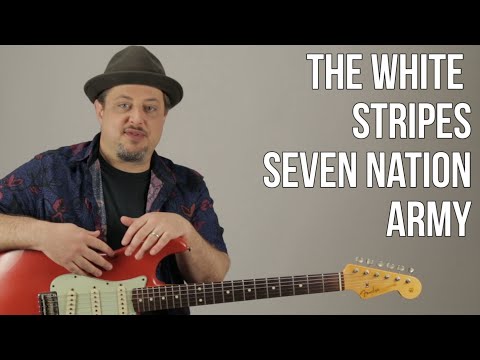
Videos
Seven Nation Army Guitar Lesson: The Riff and Power Chords
Learn Seven Nation Army by The White Stripes on guitar with Marty: the famous one-string riff, the power chords in the build-up, and how to make the riff sound huge.
Videos
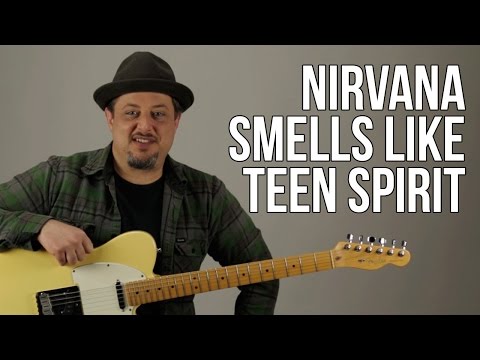
Smells Like Teen Spirit Guitar Lesson: Power Chords and Riff
Learn Smells Like Teen Spirit by Nirvana on electric guitar with Marty: four power chords, the muted strums inside the riff, and the quiet-loud dynamics.

Videos
Back in Black Guitar Lesson: Main Riff, Chorus and Rhythm
Learn Back in Black by AC/DC on electric guitar with Marty: the famous main riff, the chorus power chords, and the tight, muted rhythm that makes it groove.